HOA Reserve Fund Basics: What It Is and Why Underfunding Matters
A practical guide to reserve fund basics: authority, records, decision checkpoints, board/homeowner questions, and a jurisdiction-safe action plan.
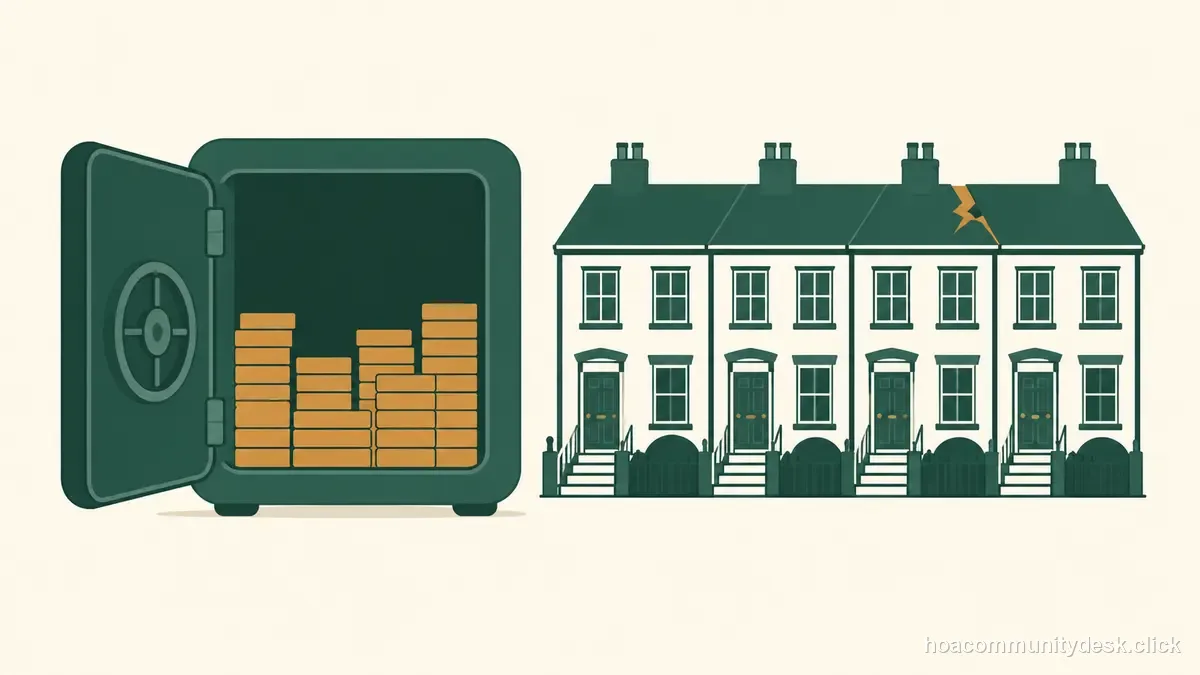
An HOA reserve fund is money set aside for major repair and replacement obligations that occur over years rather than every month. It helps spread the cost of roofs, pavement, building systems, fencing, pools, drainage, and other association-maintained components across the owners who benefit from them over time. The exact components, funding requirements, and restrictions come from the association’s obligations and applicable law—not a universal national percentage.
Start with what the association is responsible for
Reserve planning begins with the maintenance map. Identify the physical components the association must repair or replace and distinguish them from owner responsibilities. A townhome HOA responsible for roofs has a different reserve burden from a subdivision HOA that maintains only entrances and a small park. If responsibility is unclear, resolve the governing-document question before building a funding model.
Understand the two sides of reserve planning
The physical side estimates component condition, remaining useful life, and future replacement or major-repair cost. The financial side determines how current funds and future contributions could meet those obligations. A reserve study combines those perspectives. Boards should not focus only on the current bank balance, because a large balance can still be inadequate when several expensive components are approaching the same replacement window.
Reserves are not an emergency checking account
When operating cash is tight, transferring reserve money can seem easy. Before doing so, verify whether the transfer or borrowing is authorized, what repayment or disclosure rules apply, and which future project is being displaced. Repeatedly using reserves to cover routine operations can hide an assessment problem while increasing the risk of a future special assessment.
Use component-level questions
- What component is the association responsible for?
- What condition or inspection information supports the remaining life assumption?
- What replacement scope and cost basis are being used?
- When was the estimate last updated?
- How much has already been accumulated for this obligation?
- What annual contribution strategy is the board following?
Worked example: two communities with the same reserve balance
HOA A and HOA B each have $500,000 in reserves. HOA A maintains a small clubhouse and streetscape. HOA B is responsible for roofs, elevators, a parking structure, and a pool, with several replacements expected in the next decade. The identical balance says very little without the component schedule. Reserve health must be evaluated against obligations, timing, and funding plan.
| Lower future obligations | Higher future obligations | |
|---|---|---|
| Current balance | May cover a larger share of expected costs | May cover a smaller share of expected costs |
| Planning question | When will components need work? | What funding path matches component timing? |
| Board focus | Compare projected needs with available funds | Explain tradeoffs without relying on one balance alone |
Underfunding creates choices later
If contributions stay below the amount needed for expected work, the gap does not disappear. The future board may need to raise regular assessments, levy a special assessment, borrow, reduce project scope, or defer maintenance. Some of those choices can affect safety, insurance, lender review, or property marketability depending on the community. The current board should understand what risk it is transferring forward.
Overfunding questions also deserve analysis
Owners may reasonably ask why the association is accumulating money far ahead of a visible project. The answer should come from the component plan, not a desire to keep “as much cash as possible.” Review assumptions when projects are removed, responsibility changes, useful life extends materially, or estimates prove too high. Reserve planning is a model that should be updated, not a one-time savings target.
Keep reserve money and reserve records organized
Track transfers, contributions, project withdrawals, investment income, and board approvals in a way that ties cash movement to the capital plan. Bank accounts and accounting categories should be understandable to the board and any professional reviewer. If law or the governing documents require separate accounts or disclosures, build those rules into the operating procedure.
Questions owners can ask
- What major components are included in the reserve plan?
- When was the study or capital schedule last updated?
- What funding strategy is the board following?
- Which major projects are expected next?
- Were reserve funds used for operating expenses, and if so, under what authority?
- What reserve records are available through the owner-inspection process?
The location of cash does not by itself establish that it may be used for a particular purpose; confirm governing documents and applicable requirements.
When to update the plan
Revisit reserve assumptions after major projects, significant price changes, new inspections, insurance or safety findings, changes in maintenance responsibility, or a professional study update. A project completed early can change future contributions just as much as a project delayed by five years. The board should understand why the schedule changed rather than copying last year’s contribution automatically.
Track funding trajectory, not a single “percent funded” label
Reserve reports may use measures such as percent funded, baseline funding, threshold funding, or component-based projections. Those terms can be useful, but a board should understand what each measure means before treating one number as a grade. Ask how today’s balance compares with upcoming obligations, what assumptions drive the projection, and whether the chosen contribution path is expected to improve or weaken the association’s position over time.
Coordinate reserve decisions with real project procurement
A reserve study estimate is not a contractor bid. As a project approaches, obtain current scope, design, permitting, engineering, and pricing information as appropriate. Feed the completed project cost back into the next study. This prevents the reserve plan from drifting away from actual market conditions and helps explain why a contribution may need to change even when the list of components has not.
Do not confuse cash location with legal purpose
A reserve balance may sit in a bank or investment account, but the account title alone does not decide how the money may be used. Governing documents, board resolutions, accounting treatment, and applicable law may all matter. Before a large withdrawal, connect the expenditure to the planned component and preserve the approval record.
HOA rules and state statutes vary — check your governing documents and local law. Reserve-study frequency, funding requirements, permitted uses, transfers, borrowing, disclosures, account structure, and professional qualifications vary by jurisdiction and association.
Sources and further reading
- Foundation for Community Association Research — Understanding Assessments
- CAI — Best Practices: Financial Operations
- CAI — Community Association Governance Guidelines (2022)
Sources are used for general governance, fair-housing, debt-collection, or dispute-resolution principles. State-specific HOA law may impose additional or different requirements.
Frequently asked questions
What evidence matters most when reviewing an HOA reserve fund?
Review the association's maintenance-responsibility records, current reserve study and component schedule, funding plan, reserve account statements, and recent board decisions about transfers or capital projects.
Can an HOA use reserve funds for routine operating bills?
That depends on the governing documents, board authority, accounting treatment, and state law. Before transferring money, identify the approved purpose, repayment or disclosure requirements, and capital work affected by the withdrawal. Keep the authorization and update the funding plan; ask a qualified professional when the reserve restrictions are not clear.
Does a large HOA reserve balance mean the association is well funded?
Not by itself. The balance needs to be compared with the components the association maintains, their condition, expected timing, and planned contributions. Review the current reserve study or capital schedule rather than relying on the bank balance or a single funding percentage. Ask what assumptions drive upcoming project costs.
What should an HOA do if reserve assumptions change after a major project?
Record the completed scope, cost, change orders, date, and condition findings, then feed those facts into the next reserve update. Compare actual cost and timing with the study assumptions and identify why they differ. A reserve professional can help assess whether the funding path needs adjustment.
Can the HOA spend reserve money from an account labeled ‘reserves’?
The account title alone does not establish whether a particular use is allowed. Check the association’s maintenance obligations, reserve plan, board resolutions, governing documents, and applicable law before a major withdrawal. Keep the supporting project and approval records so the cash movement can be tied to an authorized purpose.