HOA Quorum Explained: What Happens When Too Few Members Show Up?
A practical guide to quorum explained: authority, records, decision checkpoints, board/homeowner questions, and a jurisdiction-safe action plan.
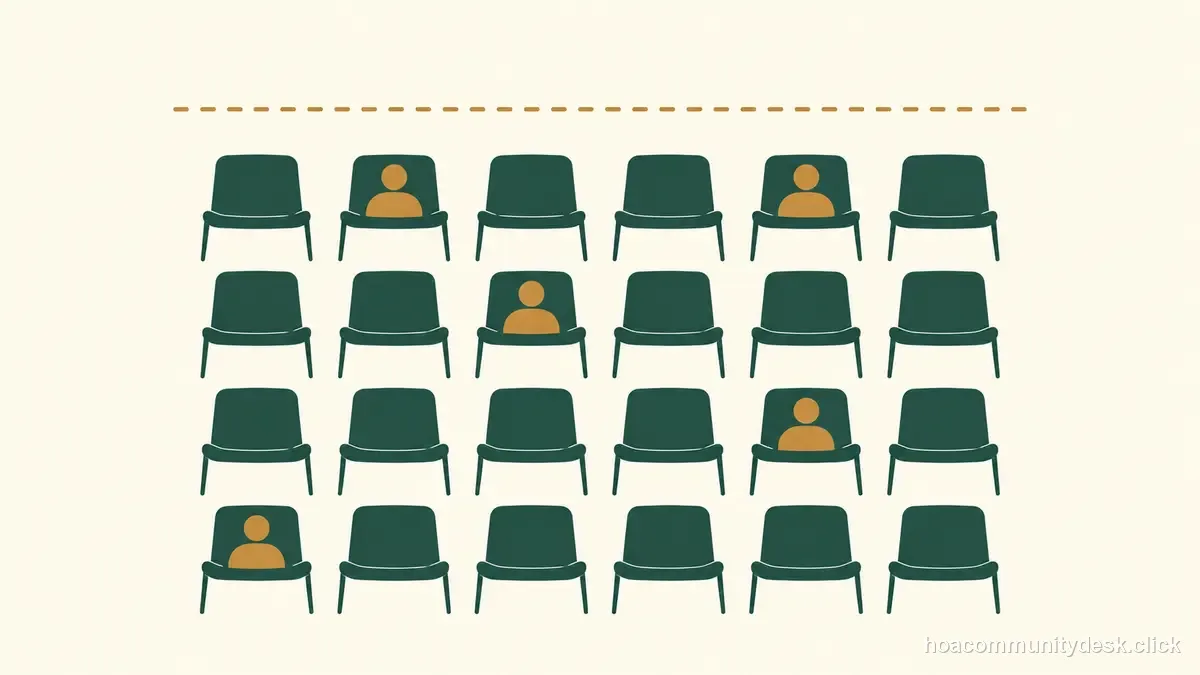
Quorum answers a narrow but critical question: is enough of the relevant decision-making body represented for the meeting to conduct the business that requires quorum? It does not tell you whether a particular proposal passed. HOA disputes become confusing when quorum, voting power, approval threshold, proxies, and attendance are treated as the same thing. Separate those concepts before counting anything.
First identify which body is acting
A board meeting and a membership meeting may have different quorum rules. A document amendment, director election, special assessment, or director-removal vote may also use an approval standard that is different from ordinary meeting quorum. Pull the current provision for the body and action involved. Do not apply the membership quorum to a board vote or assume the board’s majority rule controls a member amendment.
Quorum and approval threshold are different calculations
Suppose enough voting interests are represented to open a membership meeting. That may satisfy quorum, yet a proposed amendment could still require a separate level of affirmative approval. Likewise, a board can have enough directors present to conduct business while a motion fails because it does not receive the votes required. Keep a written line for each calculation: who counts toward quorum, what the denominator is, and what the approval rule requires.
Check what counts as “present”
Depending on the documents and law, representation may involve in-person attendance, valid proxies, mailed ballots, electronic ballots, or remote participation. These methods are not interchangeable everywhere. Verify whether the instrument affects quorum only, permits someone else to cast votes, or records the owner’s vote directly. A proxy that is invalid for voting may also affect the quorum count differently under local rules.
Confirm the voter list before the chair announces a number
Use the association’s current ownership and voting records. Resolve duplicate entries, recent transfers, multiple owners of one lot, suspended rights if legally permitted, developer votes, and other special classifications before the meeting when possible. The meeting should not become the first time the board discovers that its spreadsheet and management system disagree.
What happens when quorum is not reached?
The answer comes from the governing documents and law. The group may be limited to informal discussion, adjournment, or other procedural steps; some documents provide a reconvened meeting process or a different threshold later. Do not assume the chair can simply “lower quorum” because many owners failed to attend. If the documents contain a special reconvening mechanism, follow it exactly and preserve the notices and calculations.
Worked example: proxies create apparent quorum
Forty owners attend, and management reports another twenty proxies. Before announcing quorum, the inspector or responsible person checks whether the proxies are signed, current, directed to an eligible holder if required, and valid for the meeting at issue. Two are defective and one was revoked by the owner’s attendance. The final quorum calculation should reflect the actual valid representation, not the number of papers originally received.
Worked example: quorum exists but the amendment fails
A membership meeting reaches quorum. Owners then vote on a CC&R amendment. The proposal receives more yes votes than no votes among those participating, but the governing amendment clause requires approval measured against a larger voting base. The motion can fail even though the meeting itself was valid. This is why the chair should state the approval rule separately from the quorum announcement.
Board quorum can change mid-meeting
If a director leaves, loses connection during a virtual meeting, or is unable to participate, the board should know whether quorum remains. A recusal can raise a separate question about whether the director still counts for quorum under the applicable rule. Do not guess from parliamentary custom alone. If quorum is lost, record the time and avoid continuing substantive votes that require it.
Quorum planning checklist
- identify the correct governing provision and current amendment;
- separate meeting quorum from the approval standard for each vote;
- confirm the ownership and voting-interest list;
- define how proxies, ballots, and remote participation count;
- prepare a transparent calculation sheet;
- know the adjournment or reconvening procedure before the meeting;
- preserve the record supporting the announced quorum.
How to challenge a quorum calculation constructively
Ask for the rule, denominator, and categories used in the count. Identify the specific voting interest, proxy, ballot, or director status you believe was treated incorrectly. A focused challenge can often be answered from the meeting file. A broad statement that “quorum was fake” is harder to evaluate and easier to dismiss.
If attendance changes, verify quorum again before later business; an opening count may not describe the room throughout the meeting.
When professional review is worth it
If the disputed quorum affects an election, recall, major assessment, amendment, or other consequential action, local counsel or a qualified election professional may be appropriate. The cost of checking the calculation can be lower than repeating an invalid process after contracts, leadership changes, or owner obligations have already been implemented.
Do not use turnout pressure to rewrite the math
Low participation can be frustrating, especially when an important vote fails to launch. The solution is better outreach, accurate records, lawful proxy or ballot tools where permitted, and a reconvening process if the documents provide one. It is not to count ineligible interests, ignore revoked proxies, or announce a convenient denominator after seeing the turnout. A transparent count is more valuable than forcing a result that may later be challenged.
HOA rules and state statutes vary — check your governing documents and local law. Quorum definitions, proxies, ballots, suspended voting rights, remote participation, reconvened meetings, director recusals, and approval thresholds vary substantially by jurisdiction and governing documents.
Sources and further reading
- CAI — Community Association Governance Guidelines (2022)
- CAI — Making Sense of Association Meetings
- CAI — Governance Pitfalls for Association Boards
Sources are used for general governance, fair-housing, debt-collection, or dispute-resolution principles. State-specific HOA law may impose additional or different requirements.
Frequently asked questions
What belongs in the working file for quorum explained?
For quorum explained, prioritize membership or director roster used for the denominator, proxy/ballot rules affecting participation, meeting notice and proof of delivery, and agenda and meeting packet.
Can an HOA count a proxy toward quorum if the owner does not vote?
It depends on the proxy language, governing documents, and applicable law. A proxy may represent an owner for quorum, authorize another person to vote, or do both, and those functions are not always interchangeable. Check validity, scope, revocation, and meeting date before including it in the calculation.
Does reaching HOA quorum mean a proposed amendment passed?
No. Quorum determines whether the meeting can conduct certain business; the amendment may have a separate approval threshold. Identify the correct voting base and required affirmative votes from the governing clause, then record the quorum and approval calculations separately. Ask local counsel if conflicting documents make the standard uncertain.
What should the HOA do if board quorum is lost during a meeting?
The chair should check the association’s rules and stop substantive votes that require quorum if too few eligible directors remain. Record when quorum was lost and whether a recusal or remote-connection issue affected the count. The exact treatment depends on governing documents and local law, so do not rely only on custom.
How can an owner challenge an HOA quorum count constructively?
Ask which rule, denominator, and categories were used, then identify the specific proxy, ballot, voting interest, or director status you believe was counted incorrectly. Provide supporting records if available and request that the challenge be recorded. A focused question is easier to investigate than a general claim that quorum was invalid.