HOA Parking Violation: Towing Risk, Notice, and a Practical Response Plan
A practical guide to parking violation: evidence to gather, process checkpoints, response options, escalation triggers, and jurisdiction-safe cautions.
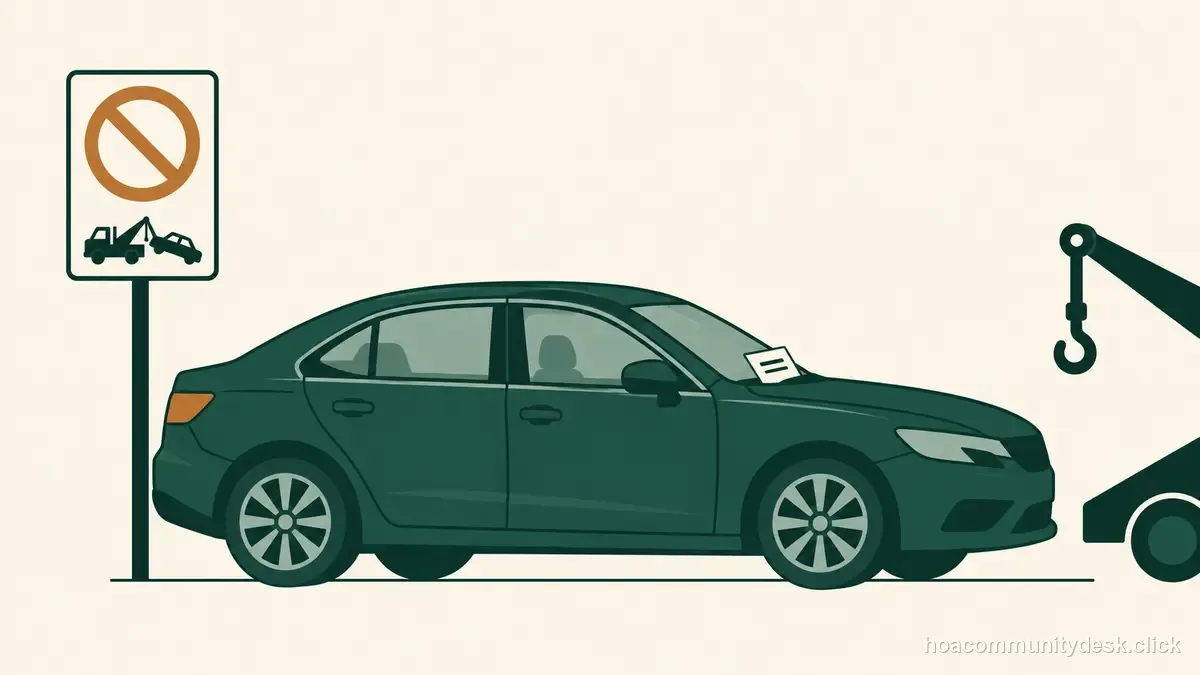
Parking cases are rarely just about a car being “in the wrong place.” The outcome can depend on who owns or controls the roadway or space, how the rule defines prohibited vehicles or conduct, whether permits or guest passes apply, what notice was given, and whether towing or fines follow a separate procedure. Before arguing about convenience, map the parking system the community actually adopted.
Identify the space before interpreting the rule
Determine whether the vehicle was on an owner’s lot, a deeded or assigned space, a common-area lot, a private street, or a public street. That distinction can change the HOA’s authority and the role of local parking or towing law. A community map, plat, declaration, parking policy, and management records may answer the question. If a public road is involved, do not assume a private rule creates the same enforcement power the HOA has over common property.
Read the definition that triggered the citation
Parking rules often distinguish overnight parking, guest parking, commercial vehicles, inoperable vehicles, oversized vehicles, fire lanes, loading, permits, and time limits. A useful notice should say which definition applies. For example, a pickup used for personal transportation may not fit a rule aimed at commercial vehicles merely because it has a company magnet. Likewise, an owner who moves a vehicle every morning may still violate a rule that prohibits parking during specified overnight hours.
Create a vehicle-and-location record
Preserve the notice, photographs, license plate, date and time, exact location, parking permit or guest authorization, and any relevant camera or gate record. If the case depends on duration, one photograph may prove presence but not how long the vehicle remained. If the dispute involves an assigned space, include the document or lease that shows the assignment. A board should make sure the evidence proves the element the rule actually requires.
Towing deserves its own preflight check
Towing can create immediate cost and access consequences, so it should not be treated as simply a stronger version of a warning letter. Check governing authority, signage, contracts, notice requirements, local towing law, emergency or fire-lane rules, and who is authorized to order a tow. Owners should document the location and signs as soon as practical if a tow is disputed. If the vehicle was removed from a public street, the relevant government or law-enforcement process may matter more than the HOA’s internal policy.
Guest passes and temporary exceptions need a paper trail
Many avoidable disputes come from informal permission. A manager tells an owner that a moving truck can stay overnight, a board member says a visiting nurse may use a reserved area, or a guest pass is entered incorrectly. Ask for written confirmation of temporary approvals and keep the permit number or portal record. Boards should publish who can grant exceptions and how they are recorded so enforcement staff are not forced to infer permission from an owner’s explanation after a citation.
Example: resident vehicle in a guest space
A resident’s assigned space is temporarily inaccessible during common-area repairs, and management tells the resident to use guest parking. A patrol later issues a violation because the plate is registered to a resident. The key record is not whether residents normally may use guest spaces; it is the temporary authorization and its dates. A clean system would log the exception against the vehicle and tell enforcement personnel how to verify it.
Apply the written vehicle definition using facts it names; do not infer a violation from occupation or assumptions.
Commercial-vehicle rules need observable criteria
Rules that use terms such as “commercial,” “work vehicle,” or “oversized” should be applied using the definition in the governing documents or policy. Relevant facts can include vehicle type, dimensions, permanent equipment, signage, registration, or use, depending on the actual rule. Boards should avoid making ad hoc judgments based on occupation or assumptions about the driver. Owners challenging the classification should address the definition point by point.
Disability-related parking requests require a different track
If an owner or resident asks for a parking exception because of a disability—for example, a closer space or a change to a permit rule—the request may implicate federal fair-housing obligations. HUD and DOJ guidance recognizes that homeowners associations can be subject to Fair Housing Act reasonable-accommodation requirements. The board should route the request through its accommodation process instead of treating it only as a routine rule exception or repeated parking violation.
How to appeal a parking citation efficiently
State the rule cited, the exact location and time, and the factual reason you believe the citation should be withdrawn or modified. Attach only the records that matter: permit, guest authorization, assigned-space record, photographs, repair notice, or other relevant proof. If the underlying parking rule is not clear, ask for the current policy and the authority under which it was adopted. If a hearing deadline appears in the notice or governing documents, preserve it even while requesting additional records.
Board audit for repeat parking complaints
If the same disputes recur, the problem may be the system rather than noncompliance. Review whether signs match the written policy, permits are reliably recorded, patrol instructions use the same definitions as the rules, temporary exceptions reach enforcement staff, and notices include usable appeal instructions. A technically valid rule can still produce unnecessary conflict if the administration is inconsistent.
Loading, deliveries, and short stops should not be treated as overnight storage
A moving van, contractor truck, rideshare vehicle, or family member unloading groceries may occupy a restricted area briefly without fitting the conduct the rule was designed to prohibit. If the policy recognizes loading or service exceptions, the notice should account for duration and purpose. If it does not, recurring disputes are a sign that the board may need clearer definitions rather than case-by-case improvisation.
Not legal advice. Parking authority, private-road status, towing procedures, signage, hearing rights, disability accommodations, and public-street rules vary by jurisdiction. HOA rules and state statutes vary — check your governing documents and local law.
Sources and further reading
- CAI — Community Association Governance Guidelines (2022)
- Foundation for Community Association Research — Governance Best Practices
- CAI — Alternative Dispute Resolution
Sources are used for general governance, fair-housing, debt-collection, or dispute-resolution principles. State-specific HOA law may impose additional or different requirements.
Frequently asked questions
Can an HOA enforce parking rules on a public street?
It depends on the governing documents and local law. First determine who owns or controls the road; an HOA may have different authority over common property than over a public street.
What should I keep if I want to appeal a parking violation?
Keep the notice, date and time, exact location, photos, permit or guest-pass record, assigned-space documentation, and any written temporary authorization.
Can an HOA tow a car without first giving a warning?
Towing requirements vary significantly. Check the governing documents, posted signs, towing contract, emergency rules, and applicable state or local law before assuming a warning is always required or never required.
What if management gave me permission to park there?
Preserve the written authorization or portal record and include it in the appeal. Informal verbal permission is harder to prove, which is why communities should log temporary exceptions.
Can disability needs justify a parking-rule exception?
Potentially. A disability-related request may need to be evaluated as a reasonable-accommodation request under fair-housing law rather than as an ordinary discretionary exception.